
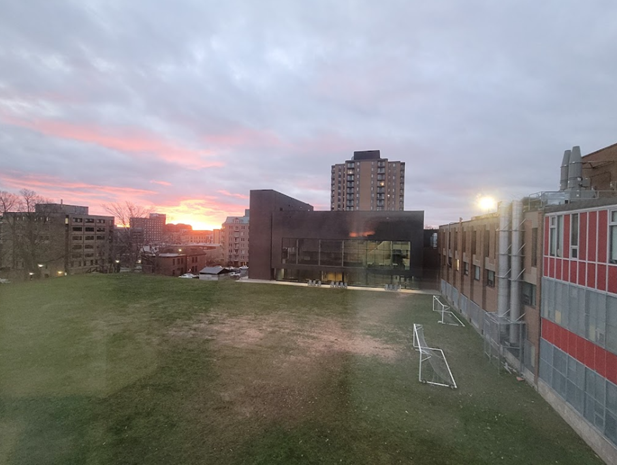
Recently, final-year mechanical engineering students enrolled in the HVAC technical elective participated in a technical tour of the new Emera IDEA and Richard Murray Design buildings. Led by their professor, Dr. V. Ismet Ugursal, the tour was hosted by ASHRAE, a global organization dedicated to improving human well-being and environmental quality through better building systems. ASHRAE develops internationally recognized standards for heating, ventilation, and air conditioning (HVAC). The tour guide, Aaron Smith, a consulting engineer involved in the mechanical design of the buildings, provided students with a rare behind-the-scenes look at the systems that keep these facilities running efficiently. From the geothermal boreholes beneath Sexton Field to the rainwater recycling system hidden below ground, the tour highlighted the sustainable engineering practices that support daily campus life. He first discussed how large construction projects are developed, explaining how engineering, architectural, and design teams collaborate to create a single functioning building. Then he moved into HVAC specifics, describing how engineers determine heating and cooling strategies for different types of buildings and campus facilities The schematic he presented revealed 60 boreholes, each six inches in diameter, located beneath the field. These boreholes act as a heat exchange system. during the winter, they extract heat from the ground, and in the summer, they release excess heat back into it. Although installing a geothermal system involves a high initial cost, Aaron explained that it’s more economical in the long run, particularly for large facilities like our campus buildings. After the hour-long presentation, students were guided to the mechanical rooms located beneath G109. This part of the tour brought the concepts from the presentation to life. The rooms were spacious and organized, with color-coded and clearly labeled pipelines showing the flow of heating, cooling, and geothermal systems. Aaron also introduced us to the ventilation system that serves the G109 auditorium. Beneath the staggered seating of the lecture hall lies a massive air plenum, a sealed space where low-velocity air constantly circulates. This low velocity helps minimize noise, ensuring the ventilation system doesn’t interfere with lectures. Inside the auditorium, fresh air enters through vents beneath the seats, while warm air from occupants is drawn out through vents at the back Deeper inside the mechanical room, we encountered a large vessel, the rainwater reservoir. Aaron explained that during rainfall, water collected from the building roofs flows into this tank, where it’s filtered and recycled for use in bathrooms and other non-potable applications. , it reduces the reliance on city water, lowering operating costs. Second, it acts as a buffer during heavy rainfall, helping prevent overflow The tour wrapped up around 6:45 p.m. with some pizza, drinks, and conversation among students and professionals. Seeing these systems firsthand helped bridge the gap between theory and practice, highlighting the impact of mechanical design on everyday life. The ASHRAE technical tour reminded us that sustainability isn’t just a concept in our textbooks, it’s built into the walls, pipes, and air around us.